Hungary - history
|
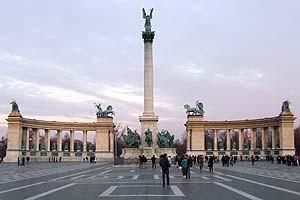
The Magyar tribes of the Carpathian basin were unified in the 9th century. Under saint-king István (Stephen) Hungary became a Christian kingdom in 1000 AD. For centuries the Magyar resisted Ottoman Turkish expansion into Europe.
The kingdom eventually became part of the multicultural Austro-Hungarian Empire, which collapsed during World War I. In the late 1930s fascist rule predominated, submitting to Nazi control. The substantial Hungarian Jewish population suffered persecution. After World War 2 a Communist regime took over. In 1956, a counter-revolution was suppressed within a few weeks by a military invasion from Soviet forces. There was a significant diaspora of Hungarians to western Europe. During the relatively moderate rule of János Kádár (his name was actually a pseudonym taken when the communist movement was underground) from 1968, Hungary began liberalising its economy, introducing so-called goulash communism. Hungary took the initiative in 1989 of opening the "iron curtain" border to Austria. The first multi-party elections were held in 1990 and initiated a free-market economy. Hungary joined NATO in 1999 and the EU in 2004. |